
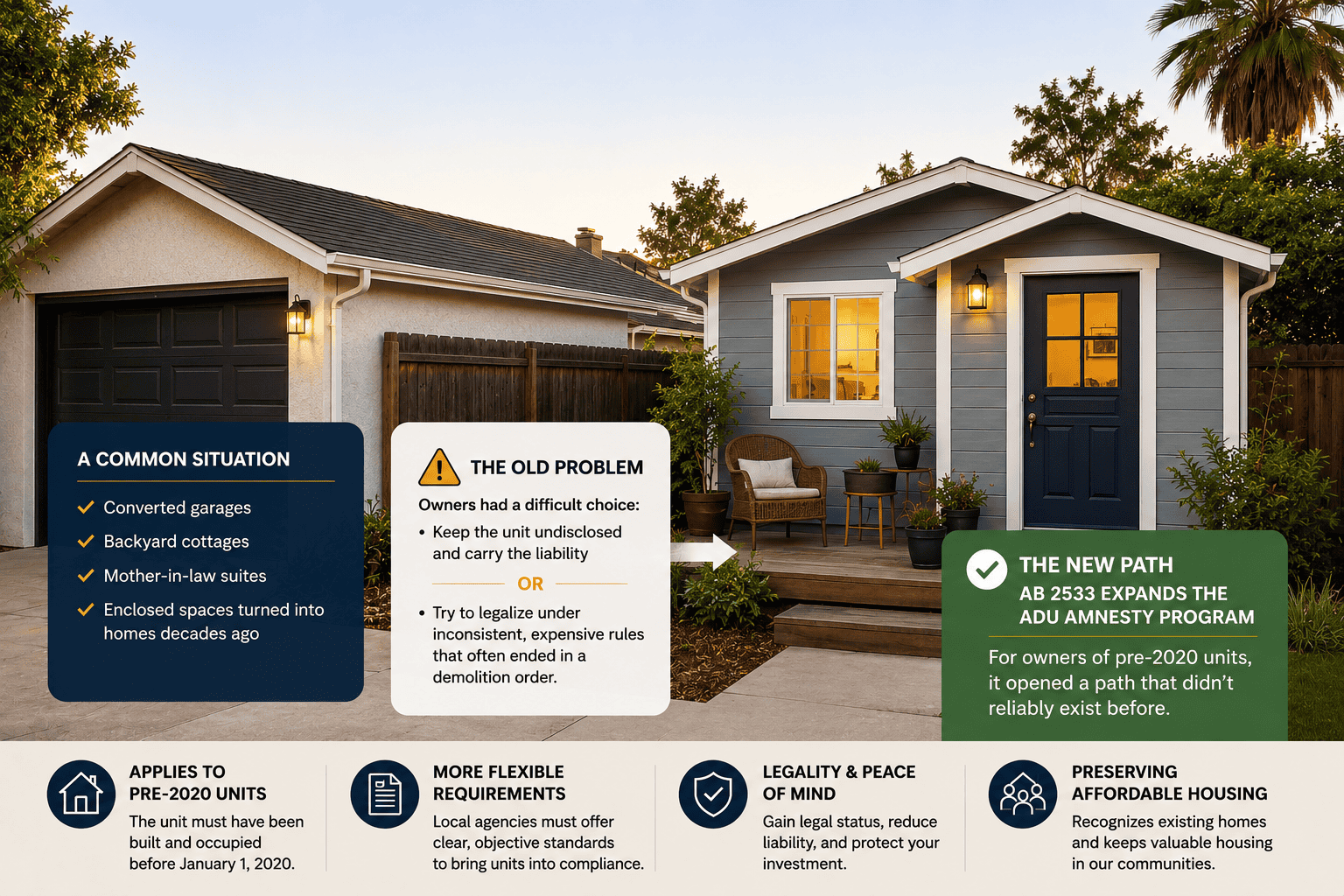
There are a lot of unpermitted second units in Los Angeles County. Converted garages. Backyard cottages. Mother-in-law suites. Enclosed spaces that quietly became dwellings decades ago and have been occupied ever since.
For years, the owners of those units faced a bad choice. Leave the unit undisclosed and carry the liability, or attempt legalization under rules that were inconsistent, expensive, and often ended in a demolition order.
California changed that. Assembly Bill 2533, authored by Assemblymember Juan Carrillo and signed September 28, 2024, took effect January 1, 2025. It expands the state’s ADU amnesty program, and for owners of pre-2020 units, it opened a path that didn’t reliably exist before.
What AB 2533 Actually Does
The law requires jurisdictions to create a legalization process that provides permits for previously unpermitted ADUs and JADUs, unless the unit is substandard under Health and Safety Code Section 17920.3.
Four provisions carry the weight:
- Eligibility now reaches units built before January 1, 2020. Earlier frameworks stopped at January 1, 2018. AB 2533 moved the date, bringing units built between 2018 and 2020 into eligibility.
- Cities cannot deny a permit based solely on code violations. Denial requires that the violation create a genuine health or safety risk. That reverses the old dynamic, where any deviation from current code could block legalization outright.
- Health and safety standards govern, not full current-code compliance. Local agencies apply habitability standards rather than requiring the unit to be retrofitted to every provision of current building code. This is the change that makes legalization financially possible for a lot of owners.
- Applicants are not penalized for having an unpermitted unit. The framework is built around bringing units into compliance, not punishing the people who come forward.
The one categorical disqualifier is classification as substandard under Section 17920.3, which covers serious safety hazards.
Who Qualifies
You may be eligible if:
- The ADU or JADU was built or converted before January 1, 2020
- The unit is not substandard under Health and Safety Code Section 17920.3
- The unit sits on a parcel with an existing primary dwelling
What doesn’t disqualify you: having no permits at all, an active code enforcement case, or an existing Notice of Violation. Those are the exact situations the law was written to resolve.
One Important Limit
This is amnesty for a pre-existing inventory. It is not forward-looking permission.
Building an unpermitted unit today creates no eligibility for future amnesty. What it creates is code enforcement exposure, retroactive fees, full current-code retrofit costs, and insurance gaps — with none of the AB 2533 protections attached. If you’re considering a new ADU, permit it.
Local Implementation Varies, and in LA It Matters
State law sets the floor. Jurisdictions keep real flexibility in how they implement, and in Los Angeles that flexibility has teeth.
The City of Los Angeles runs AB 2533 alongside its pre-existing Unpermitted Dwelling Unit Ordinance, adopted as Ordinance 184,907 and effective in 2017. The UDU Ordinance is a parallel local pathway, and it requires legalized units to provide at least one low or moderate income unit per UDU. LADBS accepts AB 2533 applications without that affordability covenant.
Read that twice if you own a property in the City of LA. Two pathways exist. They carry materially different obligations, and choosing the wrong one commits you to a covenant you may not have needed to accept.
Unincorporated LA County and each incorporated city administer their own implementation. Confirm current requirements with whichever jurisdiction has authority over your parcel before anything gets filed.
What the Process Requires
Legalization generally runs in four steps.
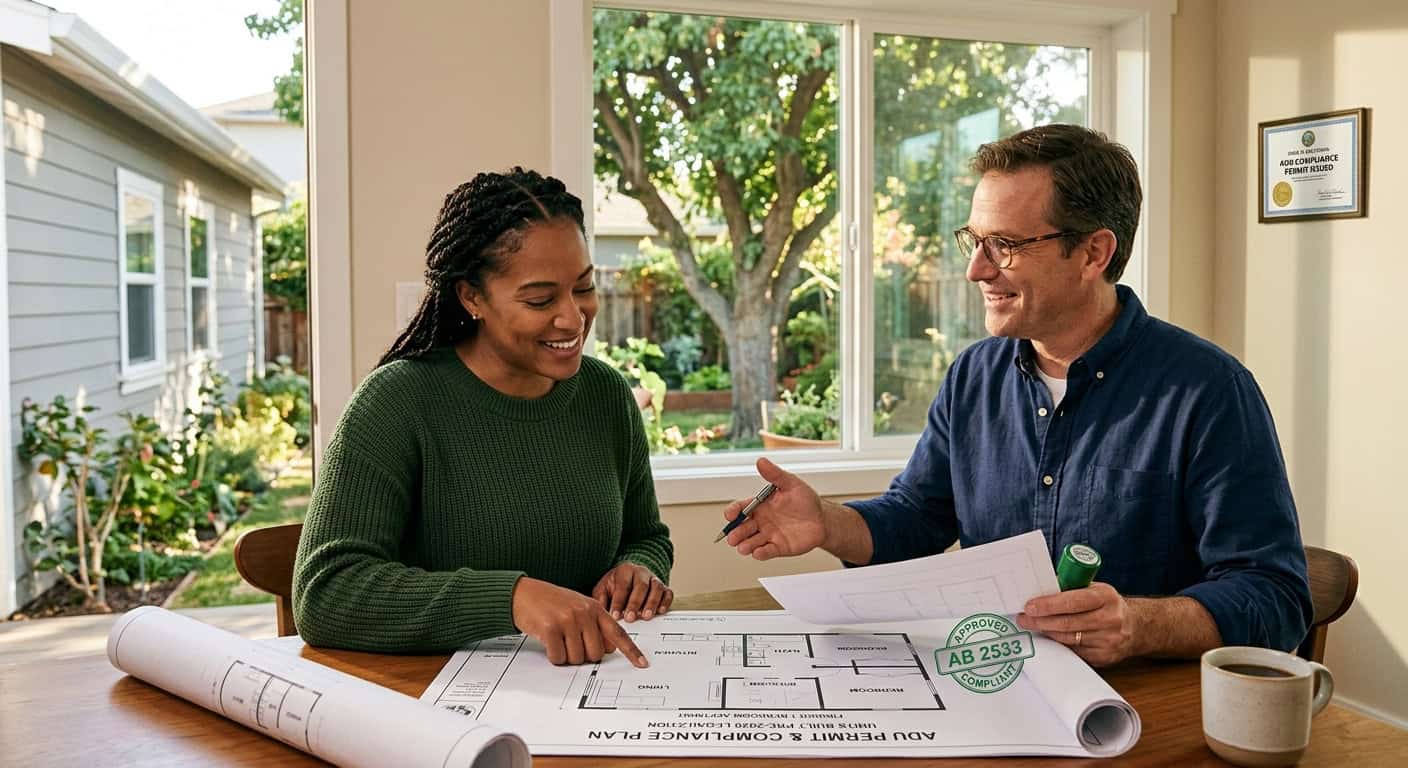
- As-built documentation. We survey the existing construction and prepare drawings recording what was actually built — dimensions, materials, structural conditions, electrical and plumbing configurations. Everything downstream rests on this being accurate.
- Code compliance analysis. We evaluate those as-built conditions against applicable health and safety standards, zoning requirements, and local jurisdiction standards. The analysis sorts the unit into three categories: what complies, what doesn’t, and the required modifications.
- Plan preparation and submission. We prepare plans documenting existing conditions and specifying the modifications needed for compliance, then submit them as a permit application.
- Inspection and correction. Inspectors assess the unit and identify necessary corrections. Modifications get completed and re-inspected until the work passes. On final inspection and release of all department holds, the unit is legalized.
- Expect that inspection to require opening walls or ceilings in places. An inspector can’t verify framing, wiring, or plumbing they can’t see, and anticipating that is easier than being surprised by it.
Why Owners Do This

- Property transactions. Unpermitted work surfaces during a sale or refinance. Appraisers, lenders, and buyers’ agents flag discrepancies between recorded square footage and what’s standing on the lot.
- Unpermitted structures create coverage complications.
- Tenant and landlord clarity. A permitted unit sits inside landlord-tenant law without the ambiguity an unpermitted one carries.
- Property value. A legalized unit is a documented asset. An unpermitted one is an undisclosed liability that transfers to whoever buys the property next.
Questions We Get
Will the city penalize me for coming forward? The framework is structured against that outcome. AB 2533 prohibits penalizing applicants for having an unpermitted unit and prohibits denial based solely on code violations absent a health or safety risk.
Will I have to demolish it? Demolition is a last resort, generally reached only where the work fundamentally cannot meet health and safety standards. Most unpermitted work can be legalized with modifications ranging from minor to moderate.
What if the previous owner built it? The current owner is responsible regardless of who did the work. Buying a property with unpermitted construction transfers the obligation to you.
Does unpermitted mean unsafe? No. Some unpermitted units are well-built and meet standards with minimal modification. Others carry real structural, electrical, or plumbing deficiencies. Evaluation against applicable standards is the only way to know which one you have.
What about units built after January 1, 2020? Those fall outside AB 2533 and follow the standard legalization path, which is a different and generally more demanding process.
How We Approach Legalization
We’ve prepared as-built documentation, code compliance analysis, and legalization plans on properties across Los Angeles County over more than a decade. We’ve been designing ADUs since 2017 and have completed hundreds of ADU projects.
The work starts with an honest evaluation of the unit and the parcel. We identify which pathway applies, what the jurisdiction specifically requires, and what modifications the unit will need to pass. You get a real number and a real assessment before you commit to anything.
Where a unit can’t reach compliance, we say so. We’d rather tell you that at the start than produce drawings that were never going to move.
The Bottom Line
AB 2533 gives owners of pre-2020 unpermitted units a defined, health-and-safety-based path to legalization that earlier frameworks didn’t reliably provide. Eligibility is broad. Denial grounds are narrow. The process is built around compliance rather than penalty.
Implementation varies by jurisdiction, and in the City of Los Angeles, the interaction between AB 2533 and the UDU Ordinance deserves attention before an application is filed. Programs and procedures continue to develop, so verify current requirements directly with your jurisdiction.
The problem doesn’t improve by waiting. It gets urgent when a sale is pending.
Have an unpermitted unit on your Los Angeles County property? Our first consultation is free. We’ll look at the unit, tell you which pathway applies, and give you a straight assessment of what legalization takes. Call +1 626-214-8651.